





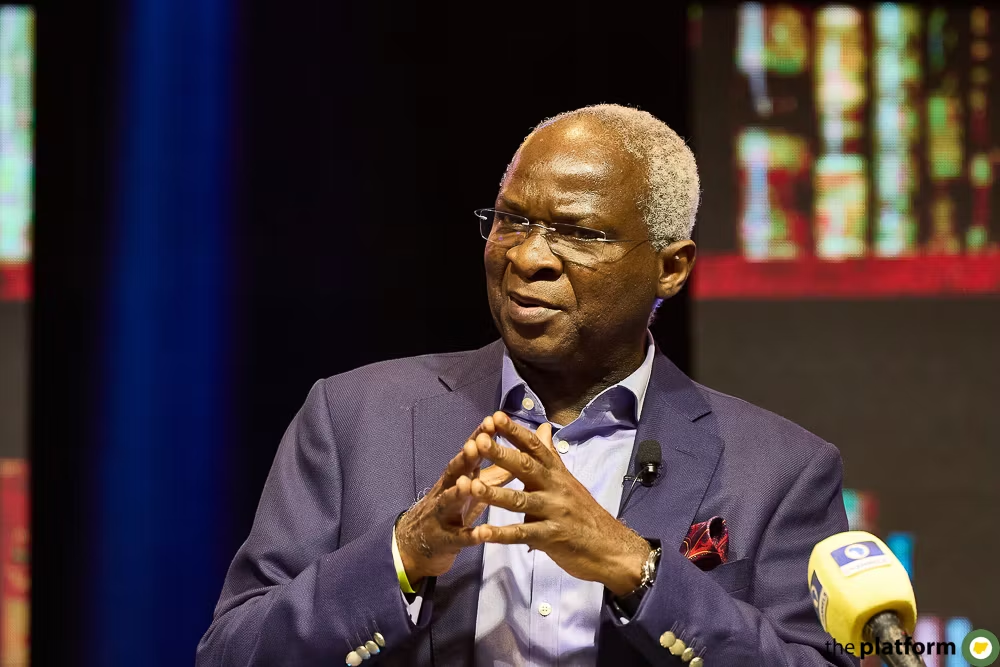























Obaseki: The Lonely Fugitive of Edinburgh

(A Comic Political Chronicle of Misrule, Mirage, and Melancholy)
By: Fred Itua
It is often said that history repeats itself first as tragedy and then as farce. In the curious case of Godwin Obaseki, former governor of Edo State, it seems to have arrived at both simultaneously, a tragic farce of self-inflicted political exile. Today, the man who once strutted like an emperor in Benin’s political courtyard is wandering the cobbled streets of Edinburgh, Scotland, seeking applause from imaginary supporters in the diaspora. The self-anointed reformer has become, quite poetically, the lonely fugitive of Edinburgh
For eight years, Obaseki reigned with the pomp of a technocrat and the temperament of a monarch. His admirers called him “the digital governor,” the one who would turn Edo into a modern marvel. But beneath the buzzwords and the billboards was a growing empire of arrogance, broken promises, and alienated allies. Now, the music has stopped, the curtain has fallen, and the man who thought himself indispensable has fled into a silence of his own making.
A Monarch Without a Kingdom
At the height of his power, Obaseki wielded influence with a mixture of charm and condescension. He banished dissenters from his political court like a digital-age Nebuchadnezzar. Party faithfuls who once toiled for him were discarded like outdated software. Those who dared question his methods were labelled “enemies of progress.”
The governor, in his infinite wisdom, turned Edo’s political space into an echo chamber. He fought everyone, his deputy, his allies, his benefactors, and eventually his own shadow. Politics, he thought, was a game of eternal supremacy, and he fancied himself the grandmaster. But as time would tell, he was merely playing chess against himself.
Today, Obaseki is left without a party, without loyalists, and-most tragically-without a home. His political godson, whom he handpicked like a crown prince, has been abandoned mid-journey. The man who prided himself on “building institutions” could not even build lasting relationships. He burned every bridge between Osadebey Avenue and the people who once carried his banner. Now, all that remains is the haunting echo of self-made isolation.
The Ghost of Policies Past
It would be unfair to accuse Obaseki of doing nothing. He did quite a lot—just not the kind of “lot” that endures as legacy. He revolutionized bureaucracy into confusion, turned innovation into intimidation, and transformed reform into theatre.
Under his watch, education was “digitally reformed” with much fanfare but little substance. Teachers were told to smile for tablets and cameras while schools without roofs stood like monuments of irony. The EdoBEST program was sold to the world as a miracle, but on the ground, parents groaned, teachers protested, and students struggled under the weight of experiments masquerading as progress.
In the health sector, promises of “accessible primary healthcare” evaporated faster than campaign jingles after elections. Hospitals remained understaffed, doctors unpaid, and citizens left to the mercy of herbalists and fate. The economy fared no better-industrial parks without industries, job creation portals without jobs, and investors that existed only in PowerPoint presentations.
Edo’s public infrastructure was a study in selective vision. Roads were fixed where cameras could reach, while rural communities languished in neglect. Civil servants worked in fear, journalists in caution, and citizens in resignation. The only sector that thrived was propaganda-heavily funded, well-oiled, and impressively efficient at manufacturing illusions.
The Abandoned Loyalists
Obaseki’s political journey is a cautionary tale in loyalty and betrayal. Those who fought his battles against perceived enemies now feel like survivors of a long, bitter war-left behind without medals or gratitude. The man who once called them comrades has since ghosted them, quite literally, across continents.
Many recall how Obaseki treated his political allies as disposable assets-useful during elections, dispensable after victory. His adopted political son, whom he once anointed as the future of Edo, now stands politically orphaned, left to grapple with the ruins of a collapsed dynasty.
Even his closest aides confess, in muted tones, that their once-invincible boss lost touch with reality toward the end. The corridors of government turned into cold hallways of suspicion. Meetings became monologues. Advice became offense. By the time his tenure ended, even his loyalists were counting down the days-not for renewal, but for relief.
The Great Flight to Edinburgh
After leaving office, Obaseki began his post-governorship odyssey with a curious choice: flight, not fight. While others retired to reflection or reinvention, he chose to reinvent himself as a globetrotting philosopher of failed governance. He took to the international stage, delivering lofty lectures on “reforms,” “resilience,” and “restructuring”- themes as hollow as the projects he left behind.
In Edinburgh, he found comfort among expatriates willing to listen to his tales of misunderstood genius. There, he reportedly laments how “politics ruined governance” and how “Nigeria is not ready for visionary leaders.” In truth, it was governance that ruined his politics-and hubris that ruined his legacy. The once-powerful governor is now a travelling apologist, desperately seeking validation that Nigeria refused to give.
Thus, the self-styled reformer has become a wandering orator of lost causes-a fugitive not from justice, but from accountability. He now peddles nostalgia to an audience too far removed to see the damage he left behind. The lonely fugitive of Edinburgh, indeed.
Okpebholo: Cleaning the Mess, Reclaiming the Narrative
But every tragicomedy needs a counterpoint, and in Edo’s unfolding story, that role is played by Governor Monday Okpebholo-the man now cleaning up the debris of Obaseki’s self-indulgence. Where his predecessor sowed division, Okpebholo is rebuilding unity. Where confusion reigned, he is restoring order.
Across sectors, the contrast is stark. In education, the new administration is reintroducing substance over spectacle-focusing on teacher welfare, classroom infrastructure, and genuine learning outcomes.
In healthcare, there is renewed investment in primary health centres and rural outreach. The economy, once a mirage of glossy brochures, is now being grounded in practical entrepreneurship, agriculture, and small business support.
Civil servants, once terrified of pay cuts and arbitrary suspensions, now speak of a new sense of belonging. Farmers in Esanland and artisans in Benin now feel seen again by their government. The Okpebholo administration may not be performing miracles, but it is performing governance-something Edo people had forgotten was possible.
More importantly, the new governor’s humility stands as an antidote to the inflated ego of his predecessor. He walks among the people, listens to their complaints, and admits what needs fixing. Governance, once a one-man monologue, has become a participatory conversation again.
The Moral of the Comic Tragedy
Every empire built on pride eventually collapses under its own weight. Obaseki’s eight-year reign was a masterclass in how not to govern-a tale of brilliance corrupted by arrogance, of vision blurred by vengeance, and of opportunity squandered by self-importance.
The Lonely Fugitive of Edinburgh may yet find solace in reflection, but history has already written its verdict. His name will not be remembered for the reforms he promised, but for the relationships he destroyed and the chaos he left behind.
In the final reckoning, the people of Edo have moved on. The state he once ruled with iron algorithms is healing under gentler hands. The laughter of market women, the hum of construction sites, and the renewed optimism of youths tell a story of restoration.
And somewhere in the distant streets of Edinburgh, perhaps in a quiet café, sits a man scrolling through the news of his homeland- watching others fix what he broke. Once hailed as a visionary, now remembered as a warning, Godwin Obaseki remains the Lonely Fugitive of Edinburgh- a tragicomic relic of Edo’s political history, wandering far from the land he once ruled, and the people he no longer understands.
Fred Itua is the Chief Press Secretary to Governor Monday Okpebholo of Edo State.


