


























Oyedele Challenges States to Cut Reliance on Federal Allocations

By Peace Erewunmi
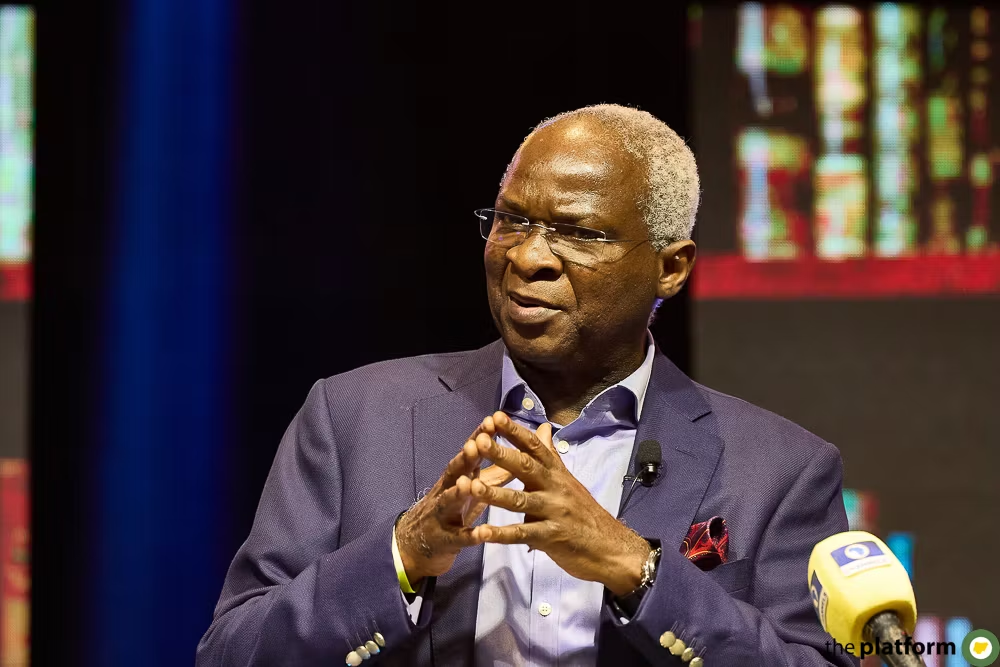
The Minister of Finance and Coordinating Minister of the Economy, Taiwo Oyedele, has urged state governments across Nigeria to reduce their dependence on federal allocations and strengthen their internally generated revenue.
Oyedele made the call during the 2026 National Council on Finance and Economic Development (NACOFED) Retreat held in Owerri, Imo State.
The retreat, themed “Strengthening Fiscal Federalism for Equity, Sustainable Development and Economic Resilience in a Volatile Global Economy,” focused on Nigeria’s revenue-sharing system and the need for stronger fiscal capacity among the different tiers of government.
According to the minister, Nigeria needs to move away from an economy that depends largely on government allocations and instead build one driven by production, investment and job creation.
He noted that monthly Federation Account allocations have increased significantly in recent years. While allocations reportedly averaged between N300 billion and N600 billion before 2023, they have now risen above N2 trillion.
Oyedele cited the N2.8 trillion distributed by the Federation Account Allocation Committee (FAAC) to the Federal Government, states and local governments in June 2026 as an example of the increased revenue available to the three tiers of government.
However, he stressed that higher allocations alone cannot guarantee prosperity or meaningful development.
The minister urged states to expand their internally generated revenue, attract private investment, support businesses and create jobs. He also called for increased investment in infrastructure, human capital development, productivity and public services.
Oyedele linked the increase in funds available for distribution to recent economic reforms, including the removal of the fuel subsidy and the unification of the foreign exchange market.
He said the reforms had significantly increased revenue available through the Federation Account but warned that governments must ensure such resources translate into tangible improvements in the lives of citizens.
The minister also called for prudent borrowing and greater transparency in public finance, cautioning governments against accumulating debts and other financial obligations without credible repayment plans.
He further advocated stronger fiscal federalism and a review of Nigeria’s revenue allocation framework to reflect the country’s changing economic realities.
Oyedele’s position is that states should not simply wait for monthly allocations to fund their operations. Instead, they should develop productive sectors within their economies, generate sustainable revenue and create an environment capable of attracting investment.
The call comes as Nigeria continues to implement economic reforms aimed at improving government revenues and strengthening the country’s fiscal position.
For Oyedele, the long-term goal should be an economy in which states can increasingly support their development through local production, investment and sustainable revenue generation, rather than relying heavily on federal transfers.


